


















































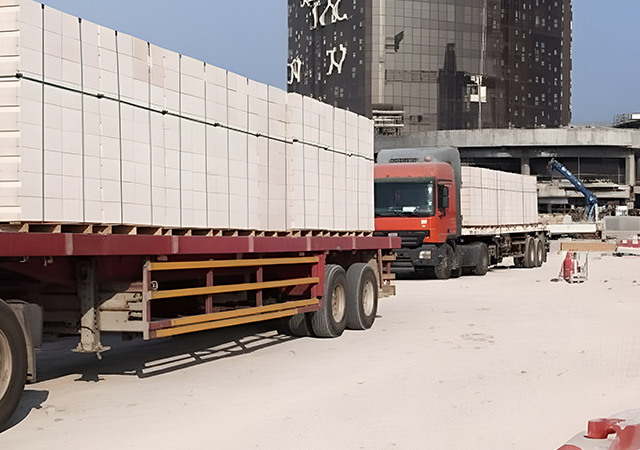
On a project the scale of The Pearl – Qatar, there was never much doubt about whether the autoclaved aerated concrete (AAC) block would perform. It was manufactured to BS EN 771-4 and QCS 2014, in strength class G2/05, with a dry density of 500 kg/cu m, thermal conductivity of 0.13 W/m·K, compressive strength of 3.2 N/sq mm and a four-hour fire rating.
Those figures mattered, but they were not the difficult part. The real challenge was everything around the product: getting the right material to site, in the right thickness, at the right time and in the right sequence and then maintaining that consistency across a large workforce and a long construction programme.
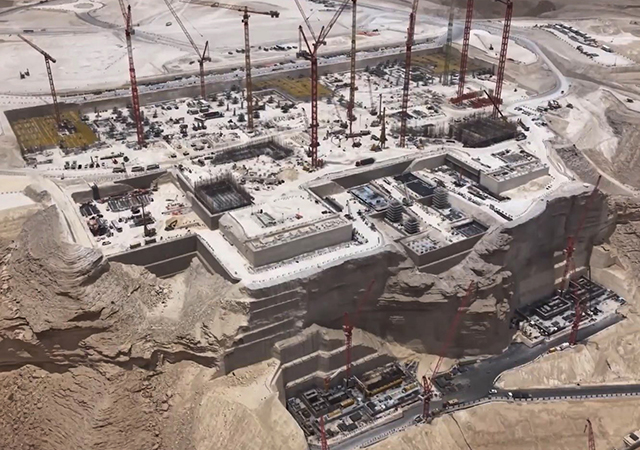
The Pearl-Qatar is a 4-million-sq-m man-made island off Doha’s West Bay, built on reclaimed land at a historic pearl-diving site. The mixed-use destination, developed by United Development Company (UDC), combines residential districts, retail and hospitality, marinas and leisure facilities.
On a development of this scale, those factors ultimately determine whether a wall package succeeds. And none of them appears on a product data sheet.
The specification was not one number
The walls at The Pearl were not built to a single thickness. Qatar Construction Specifications brought GSAS energy criteria into the project requirements, with a thermal transmittance target for external walls of approximately 0.57 W/sq m·K.
For AAC, thickness directly affects whether that requirement can be achieved by the block itself. The project, therefore, used two thicknesses:
• 250 mm AAC where the external envelope needed to meet the target through the block alone, achieving a U-value of about 0.48 W/sq m·K.
• 200 mm AAC elsewhere, where the wall’s function and exposure were different.
It may seem a minor distinction, but it has significant implications. A single thickness is simpler to procure, schedule and install, and it is tempting to specify one solution across an entire development for convenience. But that can mean carrying unnecessary material in some locations while failing to reach the desired performance in others.
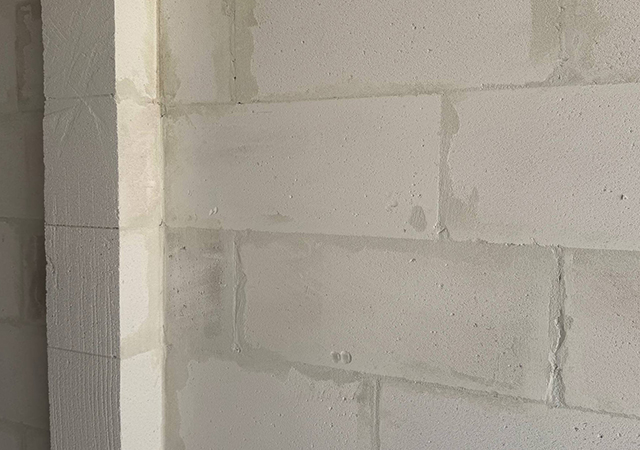
AAC is installed using thin-bed adhesive mortar.
Varying thickness according to the position and requirements of the wall is, therefore, an engineering decision. It requires more work at the design and procurement stages, but it can deliver benefits in both material efficiency and compliance. It also makes the supply operation considerably more demanding.
Continuity, not availability, is the real constraint
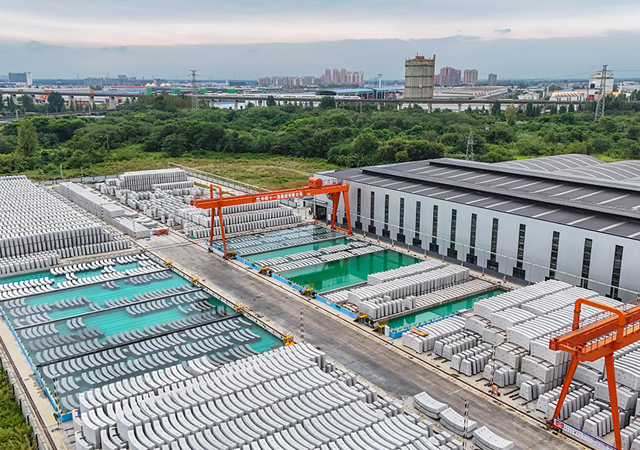
Supplying AAC blocks is straightforward; delivering them at this scale, in multiple thicknesses, in the right sequence and without delaying the site is not.
On The Pearl, the fixed 2022 World Cup deadline made maintaining uninterrupted supply a critical engineering challenge, with projects across Doha’s construction pipeline under intense time pressure.
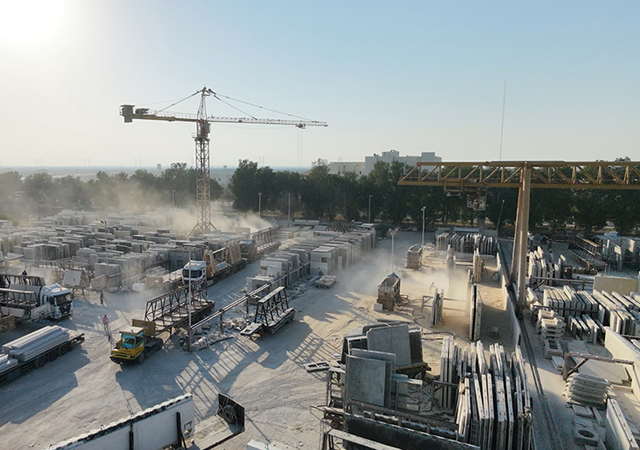
Because AAC is low-density and high-volume, it is costly to transport and difficult to store, so the project could neither stockpile large quantities nor risk running out. Every delivery, therefore, became a scheduling decision, with the supply plan having to adapt to live-site realities such as late floor releases, changing access, reordered work sequences and shifting installation programmes.
On a project of this scale, an accurate quantity take-off is critical: over-ordering wastes valuable site space and risks material damage, while under-ordering can idle crews, with lost productivity costs quickly exceeding the material’s value.
Managing take-off risk requires more than a one-off calculation: quantities must be accurate and continuously updated as the programme changes, with production capacity kept flexible enough to respond.
Consistency becomes a systems issue
On a major development, workmanship is a challenge. AAC is installed using thin-bed adhesive mortar rather than the conventional thick-bed mortar used with many traditional masonry systems. That difference is fundamental to how the wall is constructed.
The first course – set on a semi-dry levelling bed – is critical, as errors at the base propagate upward with limited scope for correction. Maintaining consistent quality across crew and shift changes over a long programme means installation procedures, training and quality control are as important to the finished wall as the block specification itself.
Managing the installation interface
AAC installation highlights the need to clearly define responsibilities between material supply, masonry installation and follow-on trades. Where multiple parties are involved, handling, installation, fixings and interface requirements must be explicitly communicated so that the performance specified at the design stage is not compromised on site. This is particularly important because AAC differs from denser masonry systems in both its installation method and its fixing requirements. A workforce accustomed to conventional masonry may, therefore, require specific training and supervision when working with the material.
The goal is to ensure the finished wall delivers the specified system performance, rather than treating product selection and workmanship as separate issues.
Preventing the failures that occur between trades
Three recurring issues illustrate why the complete wall package needs to be considered as a system.
Fixings. An expansion anchor designed for dense concrete is not automatically suitable for a cellular AAC block; it crushes its seating rather than gripping it. An inappropriate fixing may appear to hold during installation but fails to provide the required performance under load. The problem can become even more difficult during fit-out, when another subcontractor drills into the completed wall without knowing what material lies behind the finish.
The answer is not complicated: fixing requirements need to form part of the wall specification and be communicated clearly to the trades that follow.
Moisture at the base course. AAC is resistant to the passage of moisture, but it can still absorb water if exposed at its base. In Qatar’s climate, the source is not necessarily rainfall. It can be construction water, wet slabs or other moisture present during the building process. The base-course detail, therefore, needs to be considered as part of the wall’s overall thermal and moisture performance rather than simply as a finishing detail.
The first course. Because subsequent courses depend on the accuracy of the initial levelling, getting the first course right is essential. An error at this stage can propagate through the wall.
None of these problems is particularly exotic, and none is especially expensive to prevent. What makes them costly is discovering them after the work has progressed, when correction involves other trades, additional labour and programme disruption.
More importantly, all three occur at the interfaces between different parts of the construction process.
What the project teaches us
The broader lesson from a project of this scale is not simply about AAC. The material is rarely the greatest risk.
The greater risks lie in maintaining continuity of supply, achieving consistent installation across a long programme and managing the interfaces where responsibility passes from one party to another.
A wall specification, therefore, needs to go beyond the block itself. It should address thickness, fixings, the base-course detail and the mortar system, as well as the installation methodology.
The material take-off needs to remain aligned with the construction programme rather than being treated as a document issued once and forgotten.
Quality control and workforce training also need to be maintained throughout the programme, particularly where installation methods differ from conventional masonry practice.
And, wherever practical, reducing the number of handovers or, where multiple parties are involved, clearly defining their respective responsibilities can reduce the opportunities for things to go wrong.
On a large development, a wall cannot wait for the supply chain, the workforce or the programme to catch up. The real engineering challenge is making sure that none of them has to.
* Eng. Qasem Al Hariri is Technical Engineer at Doha-based ASLAN Contracting & Transportation, a supplier and applicator of autoclaved aerated concrete blocks, panels and building materials.