


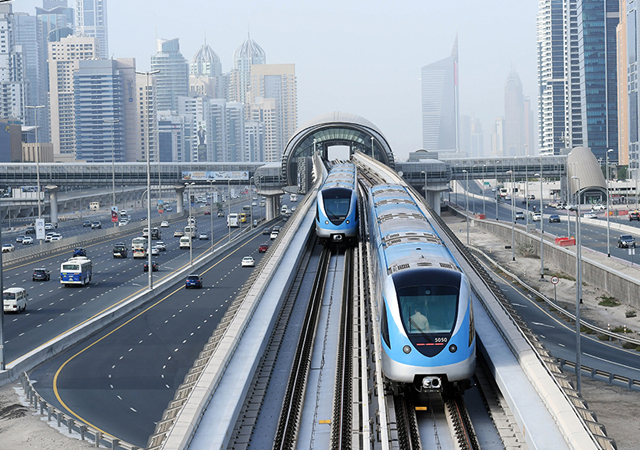

Saudi Arabia’s Riyadh Metro, the world’s longest fully automated driverless transit network, is pressing ahead with a massive new wave of expansion less than two years after its official debut.
The network was officially inaugurated by King Salman bin Abdulaziz on November 27, 2024. Since then, the metro has recorded a total of 200 million passenger journeys, according to the Royal Commission for Riyadh City (RCRC).
Marking a major milestone last month, the kingdom opened the final station on the Orange Line, completing the record-breaking six-line network as originally envisioned.
Yet, reaching the network’s original footprint was just the beginning. Riyadh immediately embarked upon expansion, kickstarting the year with the Red Line extension contract in January. Momentum will surge even further as work commences on the highly anticipated Line Seven later this year.
Western Station: Orange Line Is Complete
The RCRC recently brought the Western Station into service, completing all 22 stations on the Orange Line. The line was built by Italy-headquartered Webuild, a global leader in complex infrastructure.
As a primary backbone of the capital’s 176-km driverless network, the Orange Line initially opened on January 5, 2025, with five stations before rolling out the remainder over the course of the year. Built to combine cutting-edge technology with deep sustainability, the line features iconic hubs like the Downtown Station and the newly opened Western Station.
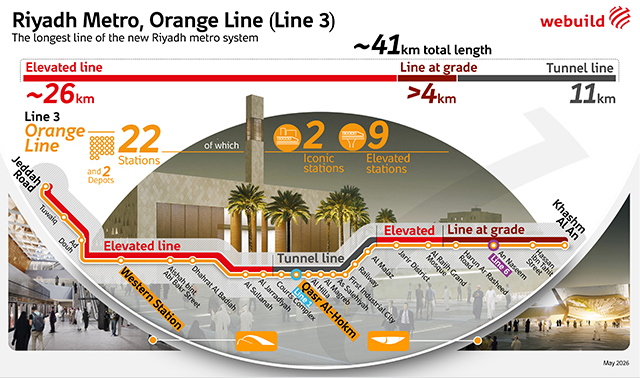
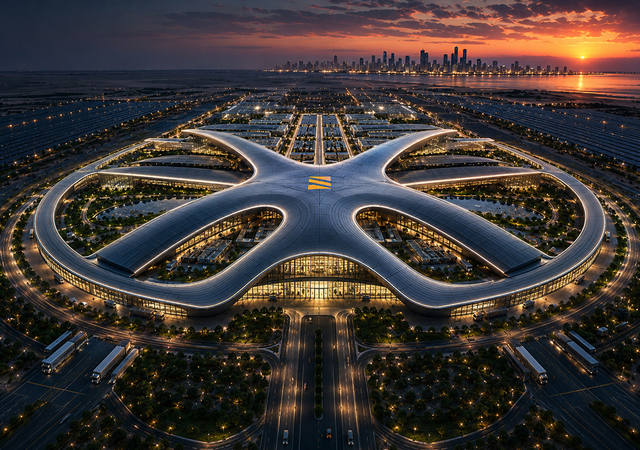
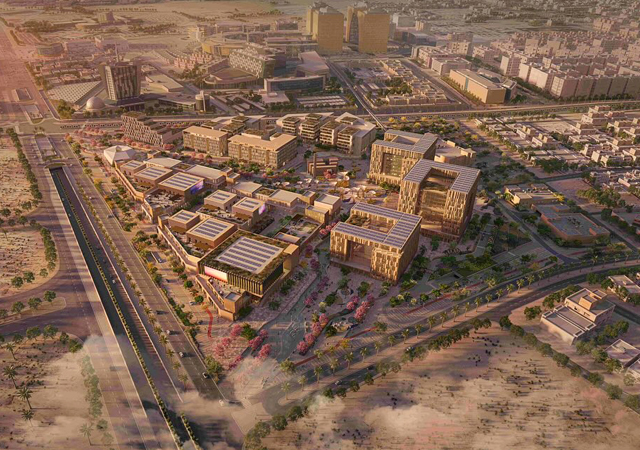
Located along one of Riyadh’s main arteries, Al Madinah Al Munawarah Road, the Western Station serves as a massive urban hub designed to redistribute intermodal transport flows. Covering 112,000 sq m, it integrates an elevated metro station, a bus terminal, a mosque, a large public square, retail areas, and underground parking for over 600 vehicles.
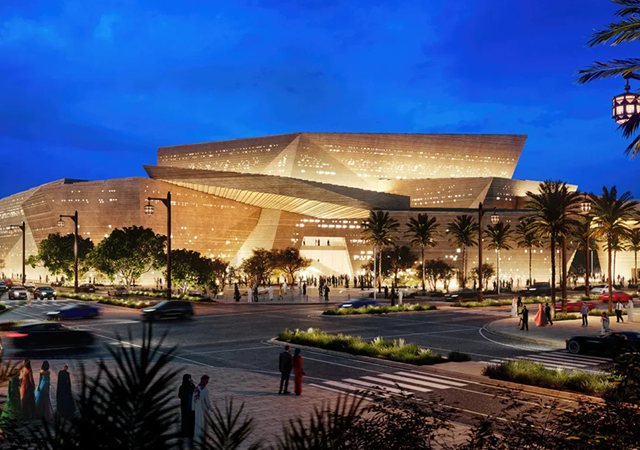
Architecturally, the station offers a contemporary interpretation of the Saudi landscape, taking inspiration from the shapes and colours of desert dunes. Horizontal structures emerge from the ground to guide natural light into interior spaces while providing shade. Two monumental arches, spanning up to 115 m and rising 24 m, support the main roofs to blend the structure seamlessly into the urban landscape.
The Western Station also boasts a strong sustainable footprint. Designed according to LEED Gold criteria, the station utilises high-efficiency equipment and self-generated renewable energy, which successfully reduced water and energy consumption even during its construction phase.
Line 7: Connecting the Gigaprojects
As the original network wraps up, Riyadh is already planning a seventh metro line to bring a new layer of connectivity across its fast-growing western districts.
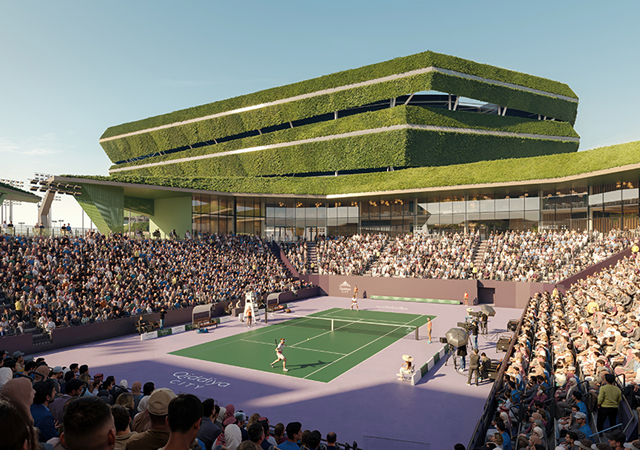
Line 7 will span approximately 65 km, featuring 19 stations (14 underground and five overground). It is designed to link the capital’s most ambitious gigaprojects, running from the Diriyah Gate development in the north to the Qiddiya entertainment project in the southwest. Along the way, it will connect King Salman Park, the New Murabba downtown development, and the expanded King Salman International Airport. Its initial implementation phase is scheduled to begin in 2026.
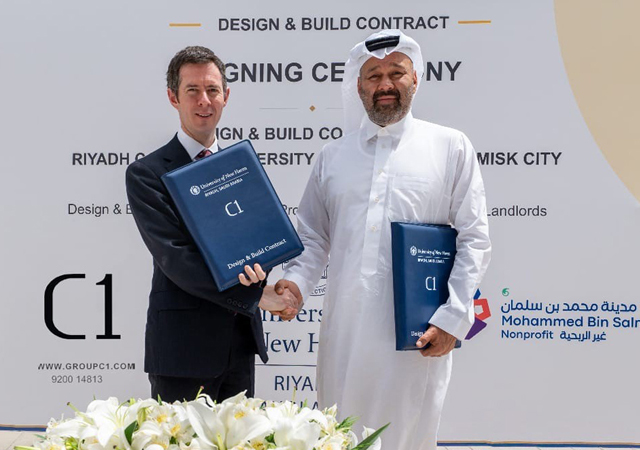
Meanwhile, work on expanding existing lines is already pushing forward. In January, the RCRC awarded a design-and-build contract for the Red Line expansion. This project will extend the line by 8.4 km from King Saud University to the Diriyah Gate Development, adding five new stations.
The Red Line extension includes 7.1 km of deep underground tunnels and 1.3 km of elevated tracks. Two stations will serve King Saud University (one for the medical city and health colleges, and another for the main concourse), while three stations will be located in Diriyah – including one planned as a future interchange with the upcoming Line 7. The extension is scheduled for completion in approximately six years.
Q-Express: High-speed rail ambitions
Riyadh’s transit ambitions stretch well beyond the metro network. The RCRC, in partnership with the National Centre for Privatisation & PPP (NCP) and the Qiddiya Investment Company, is advancing the Qiddiya High-Speed Rail Project. Known commercially as the Q-Express, this 250 km/h rail line will link the capital’s key economic and entertainment nodes in under 30 minutes.
The project aims to connect King Salman International Airport, the King Abdullah Financial District (KAFD), providing an integrated urban mobility experience that connects seamlessly with the recently launched Riyadh Public Transport (RPT) network. In a shift from the conventional procurement approach initially envisaged, the service is being developed under a public-private partnership (PPP) model.
Estimated to involve an investment of $5 billion, the line is expected to be developed in two distinct phases:
• Phase 1 will connect Qiddiya City with the King Abdullah Financial District (KAFD) and King Salman International Airport.
• Phase 2 will extend from a development known as the “North Pole” – understood to include the Public Investment Fund’s proposed 2-km-tall tower – and travel to the New Murabba development, King Salman Park, central Riyadh, and the Industrial City in the south.
Market interest in the project is exceptionally high. The RCRC received prequalification statements from firms on April 30 for the PPP package, following an April 16 deadline for the engineering, procurement, construction, and financing (EPCF) package. More than 145 local and international companies have expressed interest in developing Q-Express, including 68 contracting companies, 23 design and project management consultants, 16 investment firms, 12 rail operators, and 10 rolling stock providers. Operations are expected to begin between 2027 and 2028.