























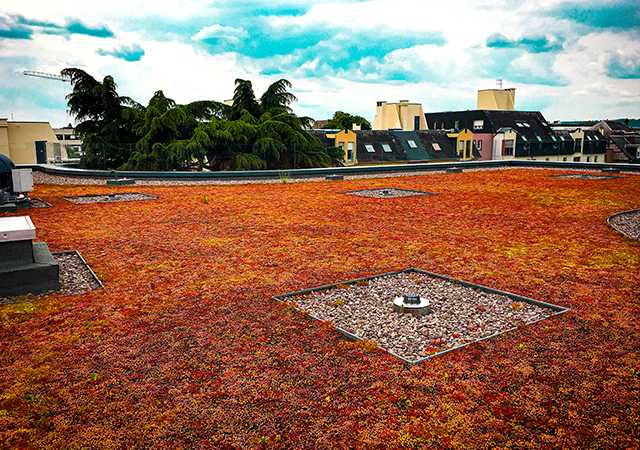
Pam Building, a European specialist in cast iron drainage solutions, is stepping up its expansion in the Middle East with the regional rollout of EPAMS, a high‑performance siphonic roof drainage system aimed at mega‑projects such as airports, malls, sports venues and logistics hubs in one of the world’s most climate‑challenged construction markets.
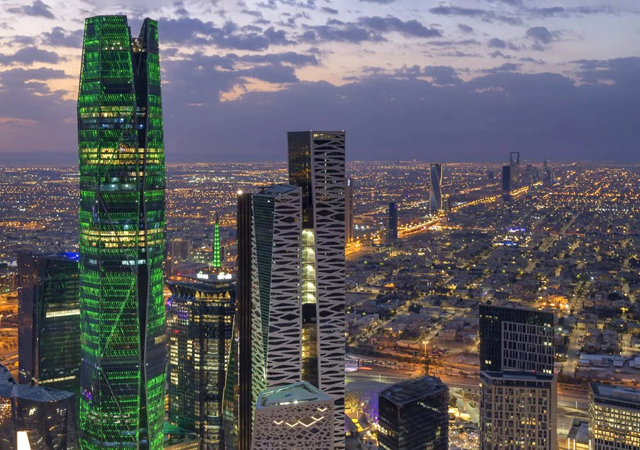
The move comes as Gulf states continue to push ahead with giga‑developments and large public infrastructure while facing a pattern of rare but intense storm events that can overwhelm conventional roof drainage systems and trigger costly damage and downtime.
Speaking to Gulf Construction in an exclusive interview, Khamis Al Majdubah, Area Sales Manager for Pam Building, notes that the environmental profile of the Middle East presents a unique set of technical hurdles.
“In the Gulf, rainfall events are rare but often characterised by extremely high intensity over short durations. Poorly designed roof drainage systems typically lead to ponding, structural overloads, water ingress, and premature deterioration of building envelopes,” Al Majdubah states.
He says these risks are amplified on large‑span roofs such as malls, airports and industrial facilities, where drainage failures can disrupt operations and strain structural safety margins.
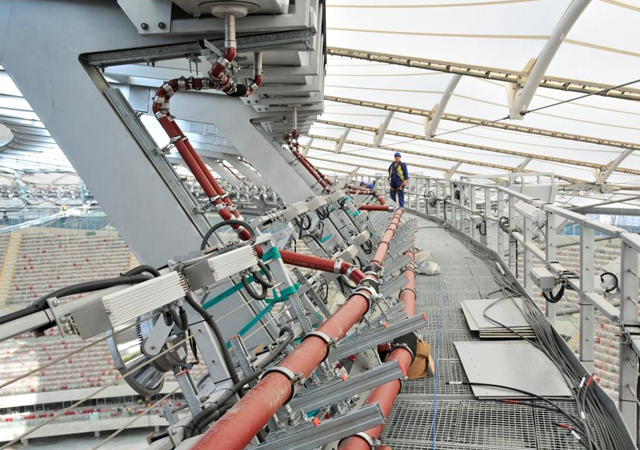
An EPAMS system installed at a stadium project.
EPAMS is designed to address these issues using a controlled siphonic principle that eliminates air intake and ensures full‑bore flow throughout the network, significantly increasing drainage capacity compared with gravity systems of the same diameter. According to Pam Building, a DN100 EPAMS outlet can evacuate up to 26 litres per second, compared with around five litres per second for a conventional gravity solution, allowing rainwater to be removed quickly even during a downpour and reducing the risk of roof ponding or structural overload.
“EPAMS mitigates these risks through controlled siphonic drainage that rapidly evacuates large volumes of rainwater without air entrainment,” Al Majdubah explains. “By ensuring full-bore flow conditions, the system prevents water accumulation even during peak storms, protecting structural integrity and reducing the risk of internal flooding or costly downtime.”
The higher hydraulic efficiency means engineers can design smaller pipe diameters and flatter horizontal runs while still meeting peak design criteria, he adds.
Compared to conventional gravity networks, Al Majdubah says EPAMS enables more targeted sizing of the drainage infrastructure. “Unlike gravity systems that require oversizing to manage peak flow conditions, EPAMS uses negative pressure hydraulics to maximise flow capacity,” he says. “The system operates with fully filled pipes, allowing engineers to design smaller diameters while maintaining very high evacuation performance.”
In practical terms, this translates into fewer roof outlets for the same catchment area, a reduced number of downpipes, and greater freedom in routing horizontal lines without slope, freeing up space for other services and architectural features.
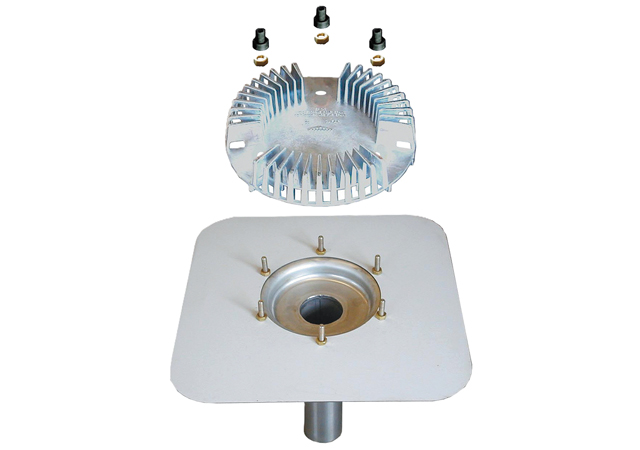
A cross-section of an EPAMS roof outlet.
Pam Building positions EPAMS as particularly suited to iconic and complex architecture, where long spans, irregular roof geometries and dense technical zones complicate coordination between structural and MEP disciplines.
The system allows long horizontal runs without gradient and reduces the number of penetrations through slabs, which can simplify coordination, minimise clashes and preserve usable interior space on projects such as retail destinations, sports venues and transport hubs, the company says.
“Siphonic drainage simplifies both architectural and MEP coordination,” Al Majdubah continues. “Compared to traditional gravity systems, EPAMS offers greater layout flexibility due to long horizontal runs without slope, reduced structural penetrations thanks to fewer downpipes, easier integration in congested technical zones, increased architectural freedom for complex roof geometries.”
He adds that predictable hydraulic modelling and integration into BIM workflows help reduce design iterations and on‑site conflicts, which can be critical on fast‑track Gulf developments.
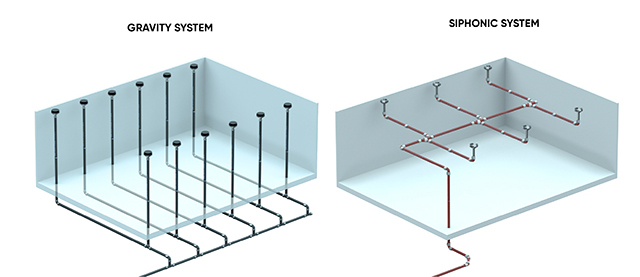
A comparison of the drainage network in a gravity system and a siphonic system.
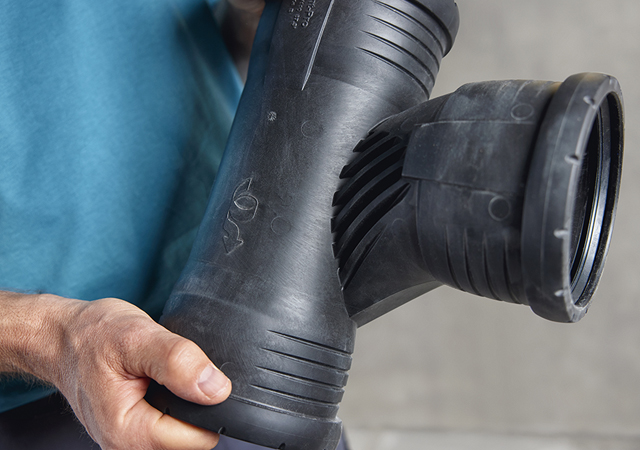
A central element of Pam Building’s value proposition in the region is the pairing of EPAMS with cast iron piping networks, which, the company says delivers significant advantages in robustness, fire safety, acoustic performance and resistance to thermal expansion in harsh climates. Cast iron offers high mechanical strength, typically exceeding 200 MPa tensile strength, making it resistant to impacts, installation stresses and dynamic hydraulic loads generated under siphonic regimes, according to Al Majdubah. This is particularly important for tall buildings and large roofs exposed to structural movements and demanding support conditions.
“Cast iron is A1 non-combustible Euroclass and does not emit toxic fumes in case of fire,” he says, noting that the material contributes zero fire load to the building and helps simplify compartmentation strategies in assets such as airports, malls and stadiums.
He adds that cast iron’s density delivers superior noise attenuation, typically reducing drainage noise by 10–15 dB compared to plastic systems – which is “especially valuable in premium assets such as hotels, airports, and mixed-use developments where acoustic comfort is a design priority”.
Thermal stability is another concern in Gulf conditions, where rooftop temperatures can exceed 60 deg C and plastic systems are prone to expansion and deformation.
“Cast iron has a low thermal expansion coefficient, significantly lower than plastic alternatives,” Al Majdubah points out. “This results in eliminating the need for expansion joints, lower stress on brackets and anchors, improved long-term alignment and sealing reliability.”
He adds that its high modulus of elasticity ensures dimensional stability under the negative pressure of siphonic operation, preserving hydraulic performance over time.
Pam Building also highlights the resilience of cast iron under UV exposure, sand abrasion and extreme temperature cycles, all common environmental elements in the Gulf. The material does not suffer UV degradation, offers strong abrasion resistance to dust and sand, and maintains dimensional stability across thermal cycles, contributing to consistent performance and reduced maintenance needs over the system’s life, the company says.
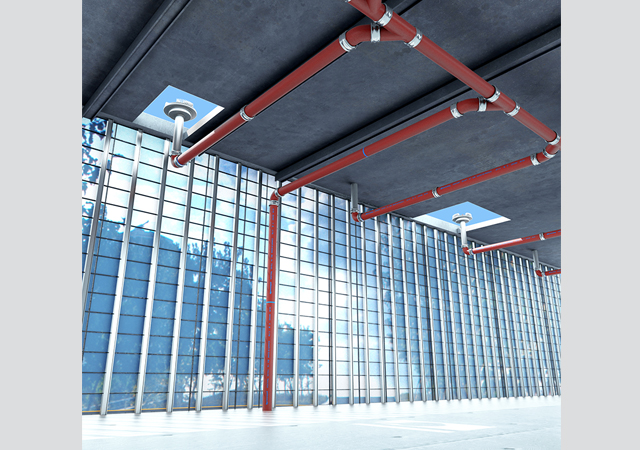
The EPAMS system allows long horizontal runs without gradient and reduces the number of penetrations through slabs.
From a sustainability and lifecycle‑cost standpoint, Al Majdubah states EPAMS combined with cast iron helps developers align technical resilience with ESG targets.
“While upfront costs are comparable to premium alternatives, the lifecycle value is significantly higher,” he says. “Benefits include reduced material use due to optimised hydraulic design, long service life with minimal maintenance, the choice of a sustainable material – cast iron is made from 99 recycled scrap material and is fully recyclable – lower risk of water damage and associated operational losses.”
He argues that for owners focused on total cost of ownership, the system “aligns perfectly with ESG and asset durability goals”.
EPAMS has already been deployed on several international reference projects, including stadiums in Morocco developed for the Africa Cup of Nations and the FIFA World Cup, such as the Moulay El Hassan Stadium and the Hockey Stadium, as well as at Geneva Airport in Switzerland and a major hospital in Luxembourg.
“The Moroccan stadium references demonstrate the system’s performance under real event conditions, where reliability is non-negotiable,” Al Majdubah remarks. Key lessons for Gulf decision‑makers, he adds, include “proven performance on large-span roofs, compliance with international venue standards, high operational resilience during major events.”
He adds systems installed in these stadiums have shown operational reliability during high‑attendance events and heavy rainfall, ease of maintenance, thanks to accessible cast iron networks, and operator confidence due to durable materials and predictable hydraulics.
“This reinforces EPAMS as a long-term infrastructure solution rather than a short-term installation choice,” Al Majdubah says. For Gulf clients planning mega‑events or large public infrastructure, he stresses that these references “provide confidence” in adopting siphonic drainage with cast iron for complex roofs and high‑value assets.
To support consultants and contractors in the region, Pam Building backs EPAMS with engineering services spanning early‑stage design through installation and commissioning. The company carries out rainfall analysis and system sizing, hydraulic calculations, 2D and 3D design support and technical assistance during execution, seeking to reduce project risk and ensure reliable performance at handover, it says.
Pam Building, which has a legacy that extends over more than 500 years, is headquartered in France and operates in more than 50 countries, supplying drainage and energy‑efficiency systems for buildings and infrastructure. In the Middle East, the company works with Trouvay & Cauvin Group as a local partner, maintaining regional stock to shorten lead times and support fast‑track project schedules.