























































































The British Standards Institution (BSI) is set to release a major update to its fire door safety standards, expanding the scope of its long-standing timber guidelines to include all fire-resistant materials such as steel, aluminium, and composites.
The revised standard, BS 8214:2026, replaces the 2016 edition and introduces a “complete system” approach to fire door safety. It marks a shift in how the construction industry treats fire doors, moving away from a narrow focus on assemblies to cover door kits and doorsets as coordinated units.
The new edition of the standard will reflect how fire doors are now designed, supplied and installed across the construction sector. It treats fire doors as a complete, coordinated system, regardless of how they are supplied to site, whether as door assemblies, doorsets or door kits.
The publication of BS 8214:2026 marks an important step forward in fire door guidance and introduces a broader and more practical approach to fire door safety, performance and compliance. The revised standard has been developed to better support those responsible for specifying, supplying, installing, inspecting and maintaining fire doors throughout their service life.
Key changes and technical updates
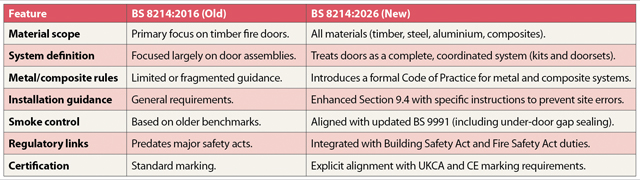
The 2026 update addresses previous industry gaps by providing a formal code of practice for metal and composite doors, covering manufacture, installation and maintenance in a consistent and structured way. Technical updates include clearer explanations of fire door classifications and the supporting evidence required to demonstrate compliance.
Key technical revisions include:
Material-specific guidance: New annexes provide tailored rules for the design, manufacture, and installation of different materials.
Installation rigour: Section 9.4 has been tightened to reduce the risk of misunderstanding and non-compliant installations on-site.
Sealing and smoke control: Guidance on sealing gaps under doors and between frames has been updated to align with BS 9991 and current best practices for materials like stone wool and mastic. The revised standard also provides improved guidance on sealing the interface between fire door frames and the surrounding structure, with clarification on acceptable evidence for materials such as stone wool, mastic and foam sealants.
Regulatory alignment: The standard reflects new legal duties introduced by the Building Safety Act and Fire Safety Act, as well as current UKCA and CE marking requirements.
Industry collaboration
The Door & Hardware Federation (DHF), which represents manufacturers and installers, was actively involved throughout the extensive revision process, ensuring that the experience and practical knowledge of the doors and hardware sector were fully represented. This involvement has helped shape guidance that is clearer, more consistent and better suited to real world application, the DHF said in a statement.
To support the rollout, BSI will host a 90-minute technical webinar on April 20. Steve Hill, DHF’s Senior Training & Compliance Officer, will join a panel of experts to discuss the practical impact on manufacturers and building owners.
The webinar will introduce BS 8214:2026, explain the key changes, and outline the practical impact of the revisions for manufacturers, installers, specifiers and building owners. It will include a question and answer session, giving attendees the opportunity to seek clarification directly from those involved in the development of the standard.