
















































Fire safety in tall buildings presents one of the most complex challenges in modern urban development. As cities around the world grow vertically to accommodate expanding populations and economic activity, high-rise buildings have become defining features of contemporary skylines.
Yet with increased height comes increased risk. Containing fire in tall structures requires a carefully coordinated strategy that integrates advanced engineering, rigorous codes, and a holistic understanding of how buildings behave under fire conditions. From an International Code Council (ICC) perspective, the path forward lies in strengthening layered fire safety design, addressing cladding performance, and ensuring consistent enforcement of modern building codes.

Tubbs and Sincaglia: Codes alone are not enough. Effective fire safety in high-rise buildings depends on a culture of continuous improvement and professional competenceindustry can address the unique complexities of high-rise fire containment.
Understanding the unique fire risks
High-rise buildings differ fundamentally from low-rise structures in how fire spreads and how occupants evacuate. Vertical shafts, façade systems, and stacked occupancies can accelerate fire and smoke movement, while evacuation logistics are more complex due to longer travel distances and reliance on protected stairwells.
Firefighting operations are also more demanding at height, often requiring specialised equipment and strategies. These realities demand a comprehensive fire safety approach that goes beyond any single system or technology.
Role of layered fire safety design
A layered fire safety design strategy is the cornerstone of effective high-rise protection. This approach combines active systems, such as detection, alarm, and automatic fire suppression, with passive fire protection measures that maintain structural integrity and compartmentalise fire. The integration of these elements ensures redundancy: if one layer is compromised, others continue to provide protection. This philosophy is embedded in the coordinated family of model codes developed by the ICC, which serve as the regulatory backbone for many jurisdictions worldwide.
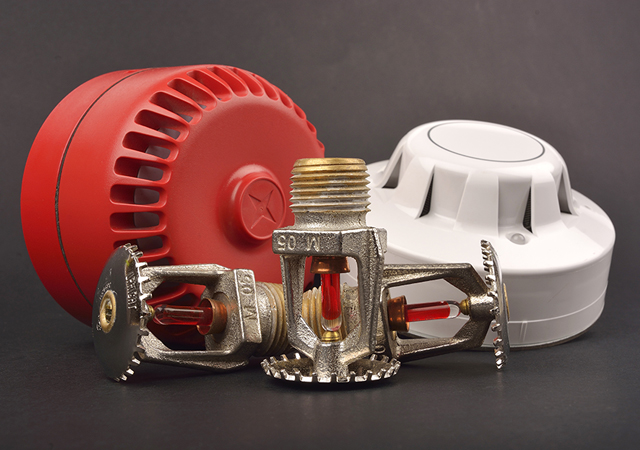
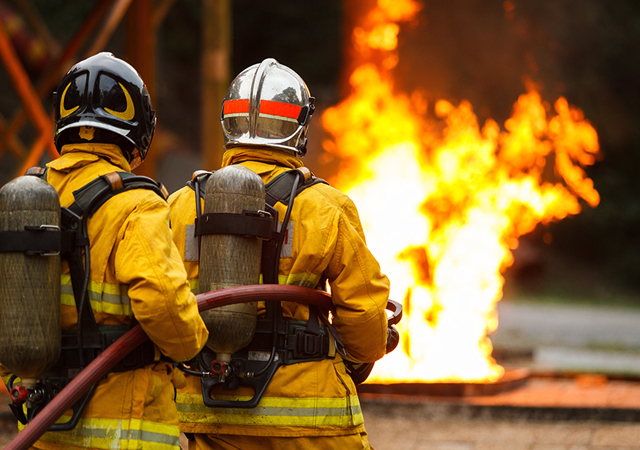
Detection and alarm systems and sprinklers ... critical to prevention of fire spread.
Detection and suppression systems
Detection and alarm systems represent the first critical line of defence. In tall buildings, early detection is essential to initiate occupant notification, evacuation procedures, and rapid response from emergency services. Intelligent fire alarm systems, integrated with building management technologies, can provide real-time information about fire location and conditions. This capability is especially important in high-rise environments, where phased evacuation strategies are often used to manage occupant movement safely and efficiently.
Automatic fire suppression systems, most commonly sprinklers, form the second line of defence. In high-rise buildings, sprinkler systems are particularly effective in controlling fires at their point of origin, reducing heat release and limiting smoke production. When properly designed and maintained, these systems dramatically decrease the likelihood of large-scale fire events. However, reliance on active systems alone is insufficient. Mechanical failures, water supply interruptions, or unforeseen fire scenarios can occur. Therefore, passive fire protection remains indispensable.
Passive fire protection and structural fire resistance
Passive fire protection provides the structural and compartmental framework that contains fire and smoke. Fire-resistance-rated walls, floors, and shafts divide buildings into manageable compartments, preventing rapid vertical and horizontal fire spread. Protected egress routes ensure that occupants can evacuate without exposure to untenable conditions. Structural fire resistance preserves the building’s load-bearing capacity, reducing the risk of progressive collapse and enabling sustained firefighting operations.
These principles are codified in modern building regulations such as the ICC and regionally adapted frameworks like the Saudi General Building Code. In high-rise applications, these codes impose stringent requirements on structural fire resistance, shaft enclosures, fire barriers, and smoke control systems. The coordinated interaction of these provisions is designed to contain fires within limited areas while safeguarding occupant evacuation and firefighter access.
Cladding and façade fire performance
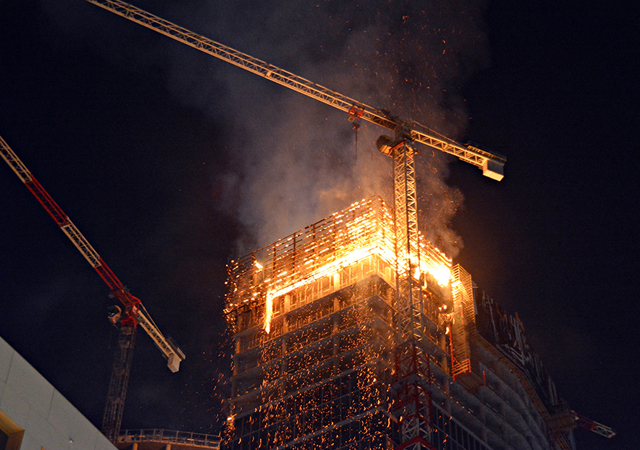
One of the most pressing contemporary concerns in tall building fire safety is façade and cladding performance. Exterior wall systems play a critical role in both energy efficiency and architectural expression, yet certain cladding materials can contribute to rapid external fire spread if not properly designed and tested. High-profile façade fires around the world have demonstrated how combustible cladding and inadequate fire stopping can allow flames to leap between floors, bypassing internal compartmentation.
Addressing cladding safety requires a rigorous, performance-based approach grounded in full-scale testing and clear regulatory guidance. Modern codes emphasise the importance of fire-tested exterior wall assemblies that consider the interaction of insulation, cladding panels, air gaps, and attachment systems. Fire propagation along façades is a system-level phenomenon; evaluating individual components in isolation is insufficient. Comprehensive testing protocols and certification processes are essential to ensure that exterior wall systems perform as intended under realistic fire conditions.
Equally important is the quality of installation and inspection. Even the most robustly tested systems can fail if improperly installed. Gaps in fire stopping, substitution of materials, or deviations from approved designs can compromise the entire façade assembly. Strong enforcement mechanisms, supported by qualified inspectors and clear documentation requirements, are necessary to maintain the integrity of fire safety strategies in tall buildings.
Importance of modern building codes, enforcement
The regulatory environment in the GCC highlights the importance of harmonising national codes with internationally recognised standards. Aligning regulations with globally tested frameworks allows the region to benefit from extensive research, proven methodologies, and accumulated practical experience. This consistency enhances design reliability, strengthens professional training, and facilitates the exchange of fire safety best practices worldwide.
However, codes alone are not enough. Effective fire safety in high-rise buildings depends on a culture of continuous improvement and professional competence. Architects, engineers, contractors, and code officials must collaborate from the earliest design stages to integrate fire safety into the overall building concept. Performance-based design methods, supported by advanced modelling tools, allow designers to evaluate complex fire scenarios and optimise protection strategies. These approaches are particularly valuable in innovative tall building designs that push the boundaries of conventional construction.
Lifecycle fire safety management
Maintenance and lifecycle management are also critical. Fire safety systems must be regularly inspected, tested, and maintained to ensure long-term reliability. Building owners and facility managers play a vital role in preserving system performance, from maintaining sprinkler and alarm systems to ensuring that fire doors and compartmentation features remain intact. Education and training programmes can help stakeholders understand their responsibilities and the importance of ongoing compliance.
Future innovations in high-rise fire safety
Emerging technologies offer new opportunities to enhance high-rise fire safety. Smart sensors, data analytics, and integrated building systems can provide earlier detection, improved situational awareness, and more efficient emergency response. Advanced materials research is leading to the development of noncombustible and fire-resistant façade solutions that balance safety with sustainability and design flexibility.
Ultimately, fire safety in tall buildings is a shared responsibility that spans design, construction, regulation, and operation. A resilient high-rise environment is achieved not through any single measure but through the deliberate integration of multiple protective layers. Robust codes, such as those developed and supported by the ICC, provide the foundation for this integration. By prioritising cladding safety, strengthening passive and active protection systems, and fostering a culture of compliance and innovation, the building industry can address the unique complexities of high-rise fire containment.
As cities continue to build upward, the stakes will only increase. Protecting occupants, emergency responders, and surrounding communities requires unwavering commitment to evidence-based standards and best practices. Through coordinated action and adherence to comprehensive fire safety strategies, tall buildings can remain not only symbols of progress but also exemplars of safety and resilience.
* US-based Paul Sincaglia serves as the ICC’s Chief Fire Protection Engineer, leveraging over 30 years of experience across fire code enforcement, firefighting, and professional consulting.
As Vice President of Codes Development for the ICC and a past president of the Society of Fire Protection Engineers, Beth Tubbs brings decades of leadership in national and international code development to her work.
The ICC is the leading global source of model codes and standards and building safety solutions. The I-Codes, standards and solutions are trusted worldwide to ensure safe, affordable and sustainable communities and buildings.